




Basketball Court Contractor in Spanish Fork, UT
Most of the basketball courts we build in Spanish Fork go onto concrete that is already in the ground. So the first question is rarely what colour you want. It is whether the slab you have is worth keeping — and that answer decides everything after it, including what it costs.
Can your existing slab be saved?
Usually, yes. If the base underneath is still sound and the problem is the surface — worn, faded, a few cracks — then repairing and resurfacing costs a fraction of tearing out and starting again.
Old concrete will not take paint on its own, though. It has to be cleaned and prepped thoroughly and then resurfaced, or the acrylic never properly bonds and it lifts a season or two later. That preparation is most of the work on a resurfacing job, and it is what decides whether the finish lasts. A quote that skips it is cheaper for a reason.
There is a point where the honest answer is no. Once a slab has chipped and spalled across its surface, patching stops being economic — you spend more chasing it than a new pad would have cost. We will tell you which side of that line you are on before you spend anything.
Freeze-thaw is what ages a court here
Concrete in Spanish Fork lives through a hard freeze-thaw cycle. Water gets into the surface, freezes, expands and works the concrete apart from the inside, a fraction at a time, every winter.
Over years that is what makes a bare slab start to chip. It is also why an acrylic coating is worth more than its colour: it seals the surface, and a sealed slab takes on far less water than an open one. The paint is protecting the concrete as much as it is marking the lines.
It is a slow failure, which is what makes it easy to ignore. The cheapest time to coat a slab is well before it needs repairing.
Tile or acrylic
Acrylic is what most courts get. It carries sand through the mix, and that grit is what you feel underfoot when you push off or change direction. It needs warmth to cure, so it is seasonal work.
Tile is the alternative, and its advantage is timing: it goes down in any weather and the lines come pre-painted, so a court can be assembled in a month when paint would never cure. It is polymer, so it is smoother than acrylic — you notice the difference in traction.
Tile costs more to put down and less to own. If a tile is damaged you replace that tile; with acrylic you resurface an area. We build both and will tell you which suits the way you actually use the court.
Before you plan a fence around it
Spanish Fork requires a building permit for fences and accessory structures. It is worth a call to the city's building division before you finalise a layout, because fence height and setback rules shape what will fit — particularly on a court that is already tight against a property line.
We handle this as part of planning the job rather than discovering it afterwards.
Our work in Spanish Fork
Spanish Fork Backyard Basketball Court
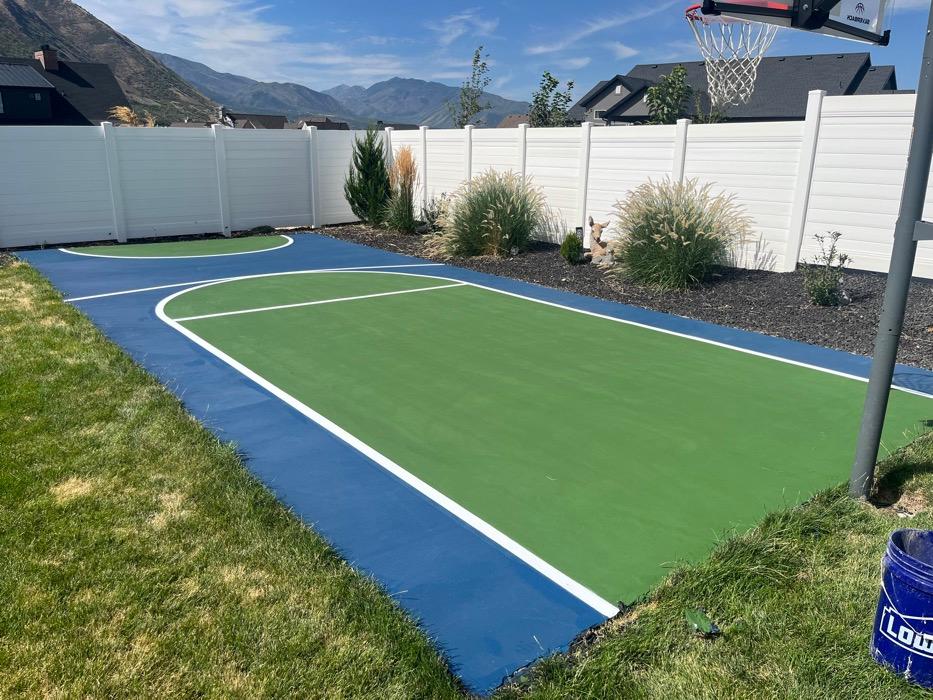
They had a slab and an old pole hoop, and wanted a court painted onto what was already there. Old concrete will not take paint on its own. It has to be prepped and cleaned thoroughly and then resurfaced, or the coating never properly bonds and it lifts later. That preparation is most of the work on a job like this, and it is what decides whether the finish lasts. The lines were measured off the hoop already standing rather than the other way round, and the layout makes the most of a limited space: navy blue surround, grass green key, a three-point line set above it, white lines throughout. Freeze-thaw is hard on concrete here, and the acrylic coating buys the slab life — it is protection as much as colour. Left bare long enough, concrete begins to chip, and once that starts the repair gets progressively harder, to the point where replacing the slab costs less than continuing to patch it.
Spanish Fork Tiled Basketball Sport Court
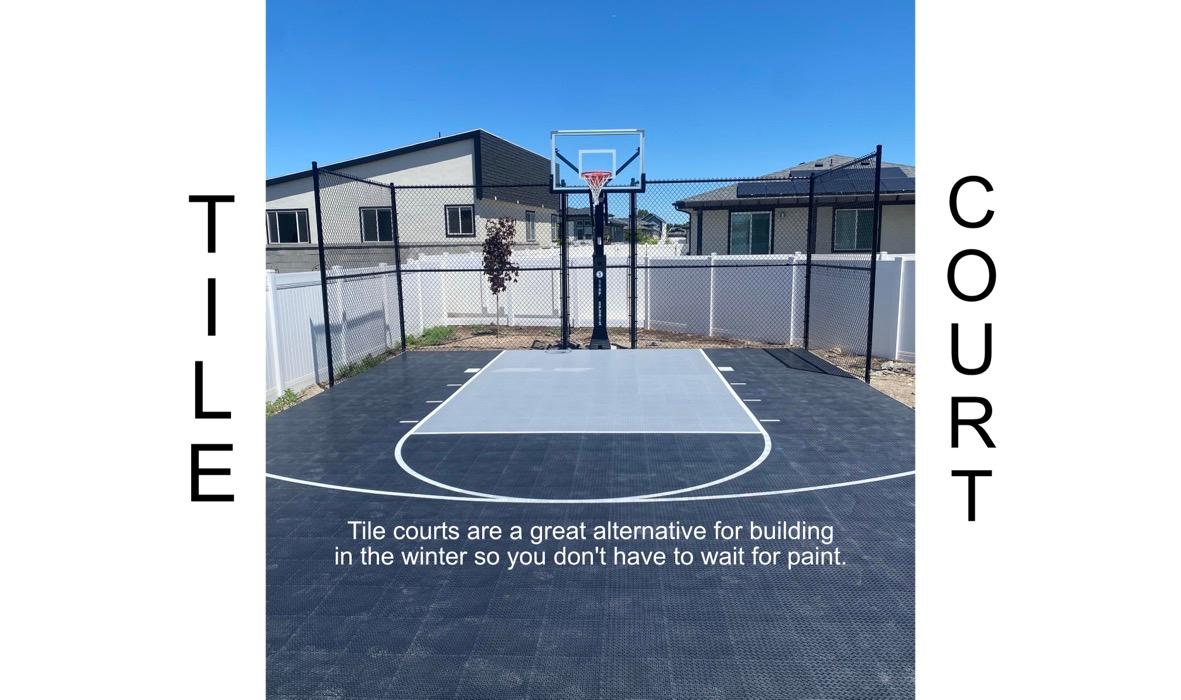
Tile is the answer when the weather will not cooperate. It goes down in any conditions and the lines come pre-painted, so a court can be assembled at a time of year when paint would never cure. The trade-off is underfoot. Tile is polymer and it does not give you the grit acrylic does — court acrylic has sand through it, and that is what you feel when you push off. Tile is smoother than that. It costs more than acrylic to put down. It is also cheaper to own: if a tile is damaged you replace the tile, rather than resurfacing a court.
Questions we get asked in Spanish Fork
How do I know whether to resurface or replace?
Look at the base, not the surface. Worn or faded coating, minor cracking, a sound slab underneath — that resurfaces. Widespread chipping and spalling, or concrete that has sunk or moved, means the base has failed and a new pad is the cheaper answer over time. We will look at it and tell you which.
How often does an acrylic court need redoing?
Roughly every seven to ten years, sooner if it takes a lot of sun and play. Cracks want dealing with as soon as they appear rather than at the next resurfacing — they grow, and a crack that has grown is a much bigger repair.
Can I put a basketball court on the slab I already have?
Often yes, and it is the cheapest way to get a court. We have done exactly that in Spanish Fork — prepped and resurfaced an existing slab and measured the lines to the hoop that was already standing.
Can you do it in winter?
Acrylic paint needs warmth to cure, so that is seasonal. Tile is not — it goes down in any weather, which is the main reason people choose it.