
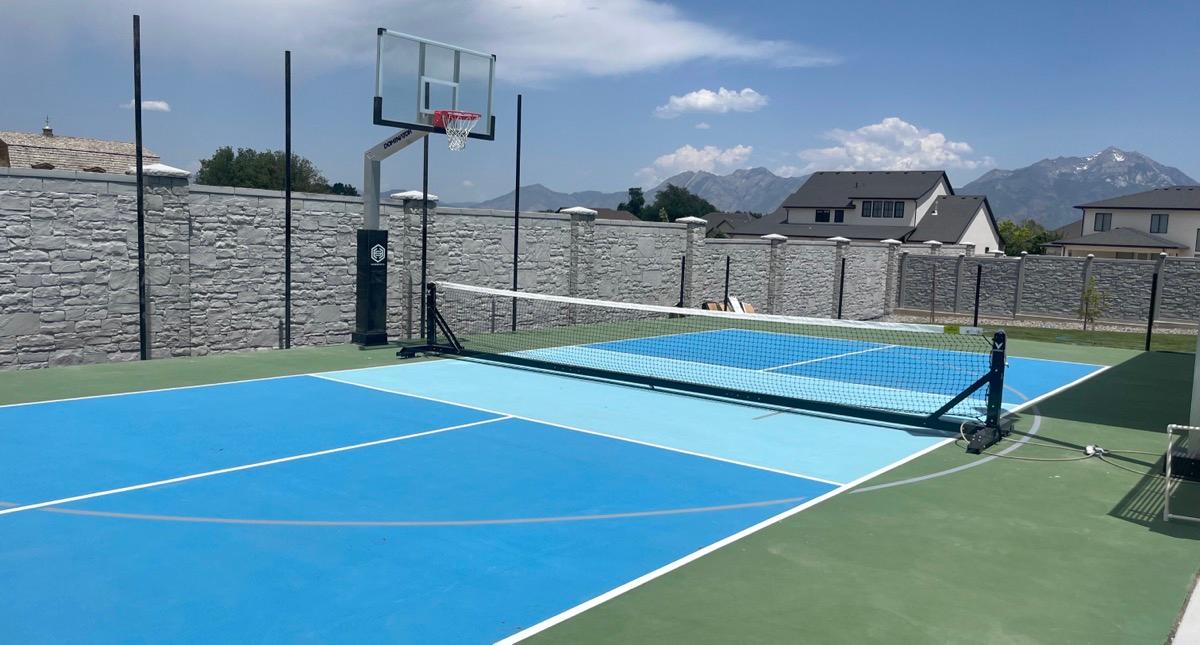




Basketball Court Contractor in Holladay, UT
Holladay has heavy clay and, often, not much room. Building the court up rather than digging into it answers both at once — it lifts the slab clear of the clay and it can recover width you would otherwise lose to a slope.
Build up, not just down
Clay is what heaves when it freezes. One way to avoid it is depth; another is height. Raising the base gets the slab high enough above the clay to avoid frost heave and gives it a solid foundation.
On a property where the court needs to sit level with something already there — a pool house, a patio, an existing terrace — building up does that job as well.
Recovering width on a narrow lot
Two things buy width in a narrow side yard. Building up to sit level with what is beside it rather than following the existing grade, and retaining the far side so the edge moves outward instead of being lost to a bank.
Between them they can be the difference between a court that works and one that is always slightly too small.
Colours that sit with the house
A grass green apron with sky blue zones and a grey non-volley zone is a combination that reads as landscaping rather than a sports facility, which matters when the court is close to the house.
Our work in Holladay
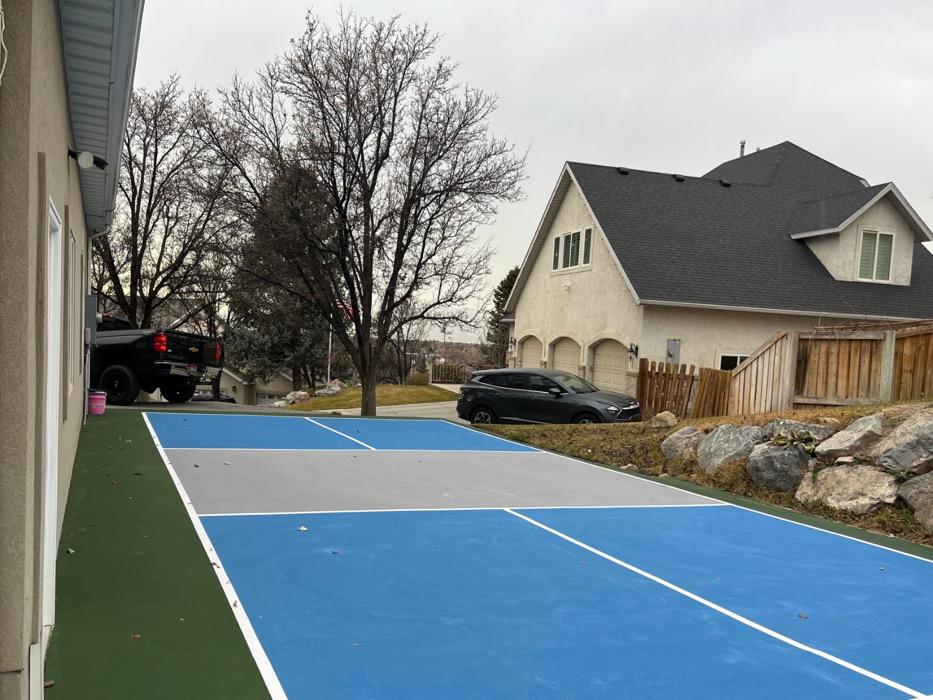
Holladay Multi-Sport Pickleball and Basketball Court
A narrow strip beside the pool house, and the job was to get as much court as possible out of it. Two things bought width. The court was built up to sit level with the pool house rather than following the existing grade, and the far side was retained — which pushes the edge outward instead of losing it to a slope. Building up did a second job as well. There is heavy clay here, and clay is what heaves when it freezes. Raising the base lifts the slab clear of it, so the court sits on solid ground rather than on something that moves with the season. Grass green outside, sky blue zones, grey kitchen.
Questions we get asked in Holladay
My yard is narrow. Is a court possible?
Often. Retaining one side and building up to level with adjacent structures recovers width. It is worth having someone look at the space rather than assuming.
Why build the court up rather than dig down?
On clay, height is one way of getting clear of the material that heaves. It also lets the court sit level with a pool house or patio instead of stepping down to it.
Does clay really cause that much trouble?
It swells and shrinks with moisture and frost. Anything sitting on it moves with it unless the base is built to take that into account.