




Pickleball Court Contractor in Mapleton, UT
Lots in Mapleton run large, and the people who call us here almost always want the same thing: a court that belongs to the property rather than one that has been dropped onto it. That shapes the colours, the size, and how we get the equipment in.
Getting back there without wrecking the garden
On a large lot the court usually sits behind planting that is already established, and the hard part is reaching it. Excavation equipment has to get in, the slab has to be poured and painted, and the beds have to be intact at the end of it.
That is a sequencing problem more than a machinery one. It is worth asking any contractor how they plan to reach the site before they quote it, because the answer changes what the job costs and what your garden looks like afterwards.
A court that does not shout
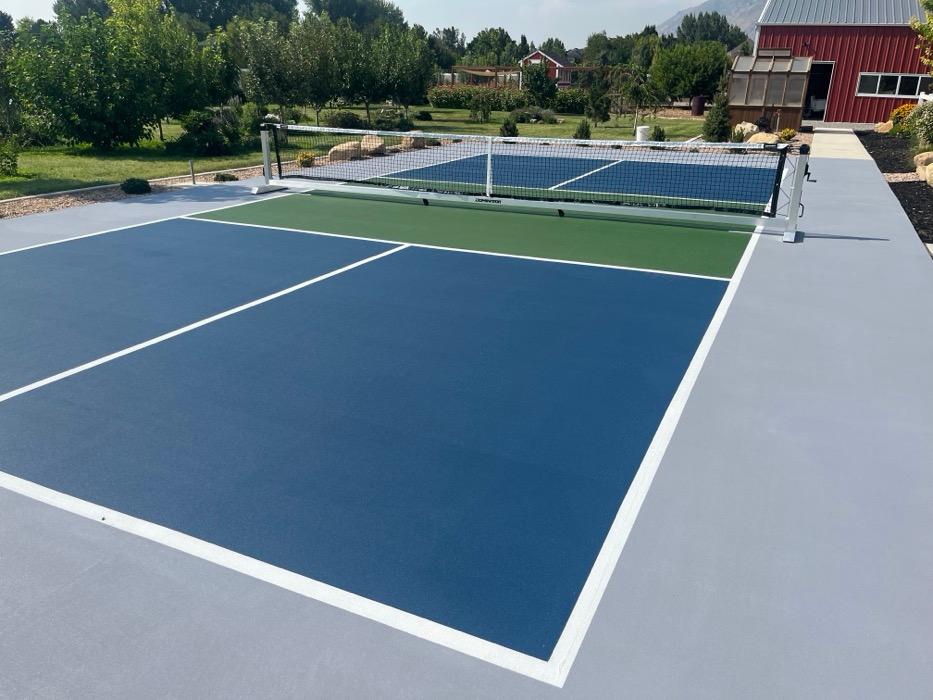
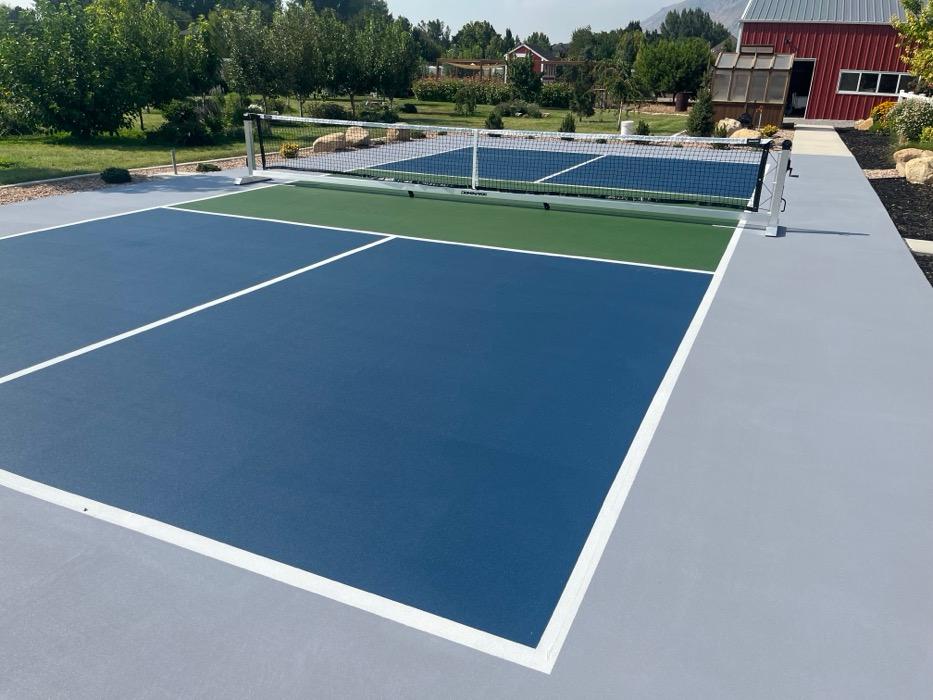
A light grey apron with a grass green non-volley zone and a navy playing surface is the combination we are asked for most here, and it is the reason why: from the house it reads as a considered part of the landscaping rather than a bright rectangle.
Room is the other advantage of a big lot. We have built courts here slightly larger than standard, which gives real space to chase a ball past the line instead of running out of surface.
Sleeves in the slab, or a mobile net
Net posts can be set into sleeves cast into the concrete, or you can use a net that rolls off. Sleeves give you a rigid, permanent net; a mobile net means the slab goes back to being open space when nobody is playing.
On a large lot where the court doubles as somewhere the family does other things, the mobile net is often the better answer. It is worth deciding before the pour, because sleeves cannot be added afterwards.
Our work in Mapleton
Mapleton Pickleball Court
They wanted a court that would last and that would not look like an intrusion on the rest of the property — something that sat with the landscaping rather than on top of it. Which set the hard part: the court had to go in behind established planting, and the planting had to survive the process. Getting excavation equipment back there without tearing up what was already in the ground shaped the whole sequence — excavate, pour and paint, with the beds still intact at the end of it. The court is built a little larger than standard, so there is real room to chase a ball past the line instead of running out of surface. The colors are the combination we get asked for most: a light grey apron, grass green non-volley zone, navy blue playing surface and white lines. There are no net sleeves set in the slab. This owner wanted a mobile net instead, so it lifts off and the court goes back to being open space for whatever else is happening that day.
Questions we get asked in Mapleton
Can you build a court without damaging my landscaping?
Usually, yes, but it has to be planned rather than discovered. We look at access before quoting and work out how equipment reaches the site. On one Mapleton court the whole sequence was built around keeping established beds intact.
How big should the court be?
A standard pickleball court is 30 by 60 feet overall with a 20 by 44 foot playing area. If you have the room, building slightly larger gives you space to play a ball that has gone past the line rather than stopping at a fence or a lawn edge.
Do I have to have net sleeves in the concrete?
No. A mobile net is a common choice here, particularly where the court is also a patio or somewhere the kids ride bikes. Decide before the pour — sleeves have to go in while the concrete is wet.