
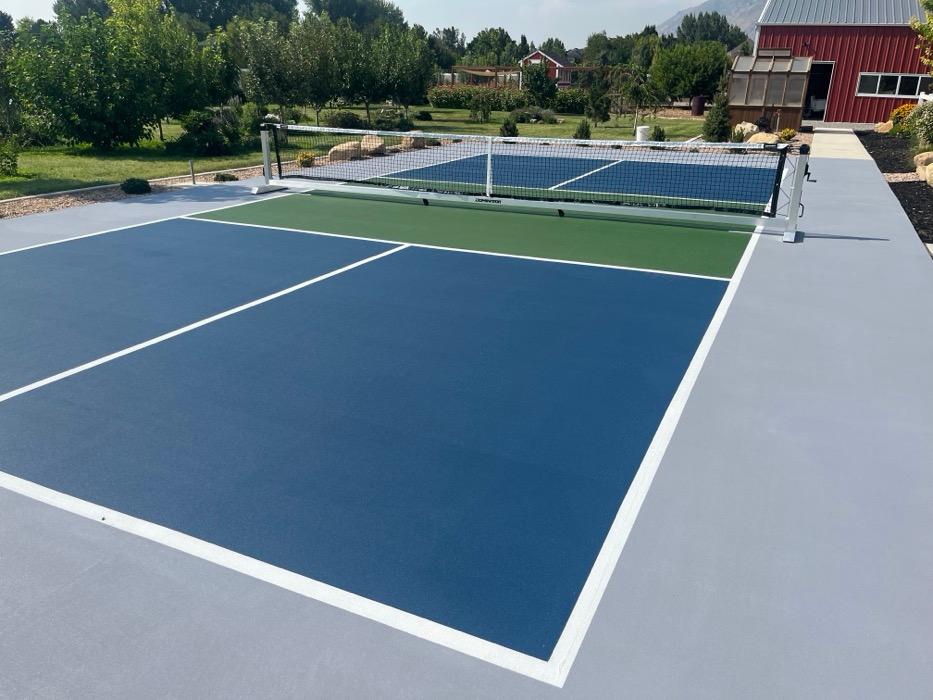




Pickleball Court Contractor in Highland, UT
Highland sits on clay, and the courts we build here are often squeezed into a space that is narrower than the owner would like. Both point at the same two decisions: how deep to dig, and where the water goes.
Dig deep on clay
Clay swells when it takes on water and freezes. The answer is depth — enough for drainage, enough base to carry the foundation, and enough to get below where frost reaches.
It is the least visible money you will spend on a court and the money that decides whether it is still flat in ten years.
Retaining walls buy width, and raise a question
A cinderblock retaining wall is about as narrow as poured concrete, so it hands the court back the width a sloped bank would have taken. On a tight lot that is often what makes a full-size court possible at all.
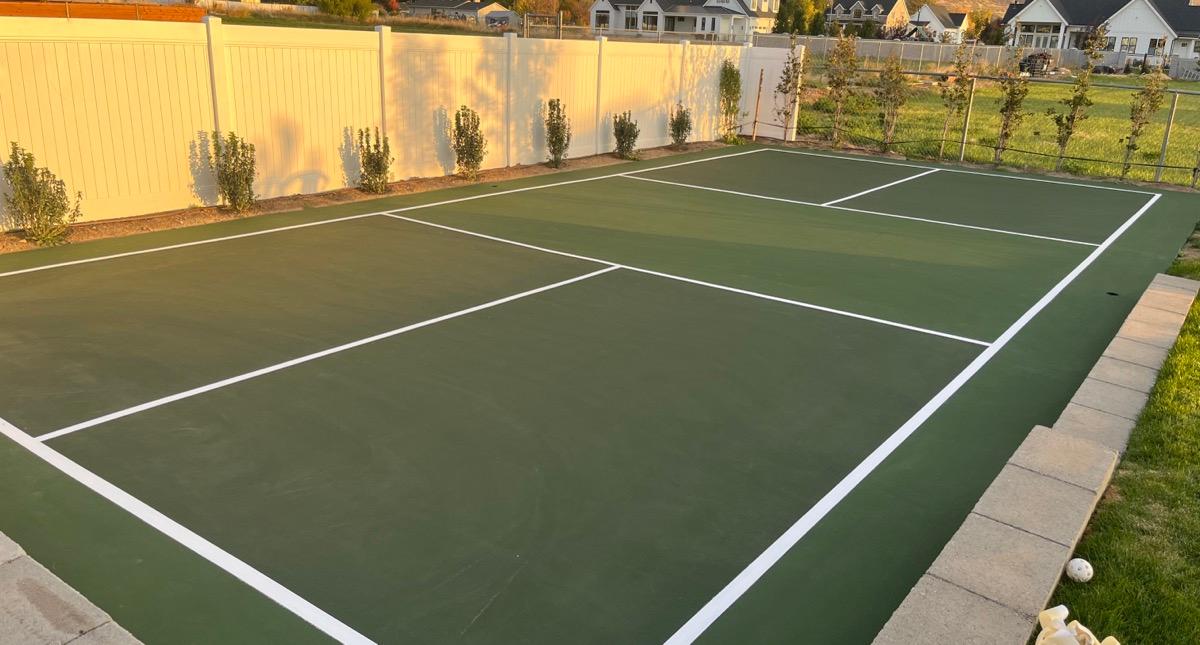
But a wall is the one direction water cannot go. Either the court slopes away from it, or you build a drainage gap between the court and the wall. Which one depends on where the drainage already sits — on the court on this page, sloping away was the simpler answer because the drainage was on the opposite side.
Roller nets and open sleeves
Where a court doubles as usable space and the net comes off often, a roller net is worth it — not just for convenience, but because sleeves left open in a slab fill with water.
Small detail, easy to overlook when specifying, annoying every spring afterwards.
Our work in Highland
Highland Pickleball Court
Another narrow space, and another way to solve it. Cinderblock retaining walls are about as narrow as poured concrete, so they hand the court back the same width a concrete wall would. Walls always raise the drainage question, though. Water has to go somewhere, and a wall is the one direction it cannot. Either the court slopes away from it, or you build a drainage gap between the court and the wall. Here the drainage already sat on the opposite side, so sloping away was the simpler answer. Underneath is clay, so the dig went deep — enough for drainage, enough base to carry the foundation, and enough depth to get below frost. Full-size pickleball with a roller net. They use the space for more than pickleball and take the net off often, and a roller means no open sleeves left in the slab to fill with water.
Questions we get asked in Highland
How deep does a court foundation need to be on clay?
Deeper than a quote for flat, stable ground would assume — enough for drainage, base support and frost depth. It is the part worth asking a contractor to be specific about.
Will a retaining wall cause drainage problems?
It can. Water has to be given a direction, either by sloping the court away from the wall or by building a drainage gap between them. Either works; doing neither does not.
What is a roller net?
A net on a wheeled base that rolls aside instead of sitting in sleeves cast into the slab. Better where the court is used for other things, and it avoids leaving open sleeves to fill with water.