




Basketball Court Contractor in Salt Lake City, UT
On the bench above Salt Lake City the slope is the whole design problem — and so is what the city expects you to do with the water that runs off it once you have added a court.
The retaining wall decides how big the court can be
On a steep lot every inch the retaining wall takes in width is width the court does not get. A rock wall eats the space. A concrete wall does the same job in a much narrower footprint.
That difference is often what lets a court come out full size instead of compromised. It is worth asking about specifically when someone quotes you a retained court on a slope.
Drainage policy and how much concrete you can add
This is older ground, and drainage rules came in after much of it was built. They matter now: what the city limits is how much of a property can be non-permeable — surfaces like concrete that create runoff.
Add enough hard surface and you may be required to build drainage to compensate. On a hillside that is not a formality — runoff affects everyone below you. Sometimes a property already has enough lawn to the sides to take it; sometimes a swale has to be built.
Either way it is worth establishing before the design is settled, because it can change what you are allowed to pour.
Fencing on a retained court
On a court that sits above a drop, fencing is what keeps a game going rather than sending someone down the hill after the ball. Four feet is enough for most pickleball courts; next to a real drop-off, six or eight feet saves a great deal of walking.
The ends matter most, because that is where balls are lost. It can be added later, but it is cheaper designed in.
Our work in Salt Lake City
The Avenues Multi-Sport Court, Salt Lake City
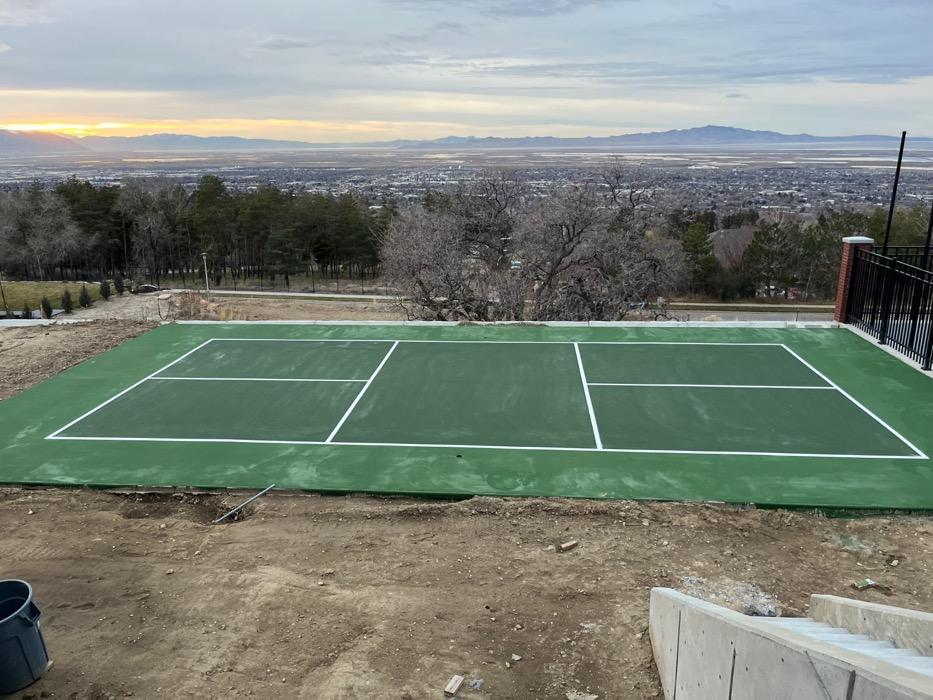
They wanted a pickleball court on a slope, and the slope was steep. On ground like that the retaining wall is the whole design problem: every inch it takes up in width is width the court does not get. A rock wall would have eaten the space. A concrete wall does the same job in a much narrower footprint, and that difference is what let this come out full size instead of compromised. Grass green outside with forest green zones and kitchen, white lines, pickleball only. No fence on this one. We recommended it and they may add it later — on a retained court above a drop, fencing is what keeps a game going instead of sending someone down the hill after the ball. Four feet is enough for most pickleball courts; next to a real drop-off, six or eight feet saves a great deal of walking. The ends matter most, because that is where balls are lost.
Questions we get asked in Salt Lake City
Can I build a court on a steep bench lot?
Usually, with retaining. A concrete wall rather than a rock wall keeps the footprint narrow, which is often what makes a full-size court possible.
Will the city limit how much concrete I can add?
It may. Drainage policy governs how much of a property can be non-permeable, and beyond a threshold you may need to build drainage to compensate. Establish it before designing.
Do I need a fence?
On a retained court above a drop, we strongly recommend it — at the ends first. Four feet suits most pickleball; six or eight feet next to a real drop-off.