




Tennis Court Construction in Orem, UT
A tennis court is 60 by 120 feet. At that size a conventionally reinforced slab will crack, so the pour has to be post-tension — and on a mature Orem lot, the other half of the job is getting the tree roots out before anything is poured.
Why a tennis court has to be post-tension
Post-tensioning runs steel cables through the slab and tensions them after the concrete has cured, holding the whole pour in compression. That is what stops a slab this large cracking as it ages and the ground moves under it.
The build is a six-inch slab with a twelve-inch thickened edge around the outside, and cables tensioned in both directions across the court, each stressed to 33 kips.
Roots are the excavation
This part of Orem has a lot of mature trees, and trees mean roots. The excavation has to be thorough and deep enough to take the roots out with them, because a root left beside a court will lift it later.
That is slower and more expensive than a clear site, and it is worth knowing before you get a quote that sounds low.
Fencing and lighting on a tennis court
A ten-foot fence right the way round is what a tennis ball needs — and proper gates rather than the open corners a pickleball court can get away with, because a gap at the corner of a tennis court is a ball in the neighbour’s garden.
Lighting goes on full twenty-foot poles aimed downward, so the court is bright to play on without throwing light across the neighbourhood. That matters on a residential street.
Our work in Orem
Orem Tennis Court
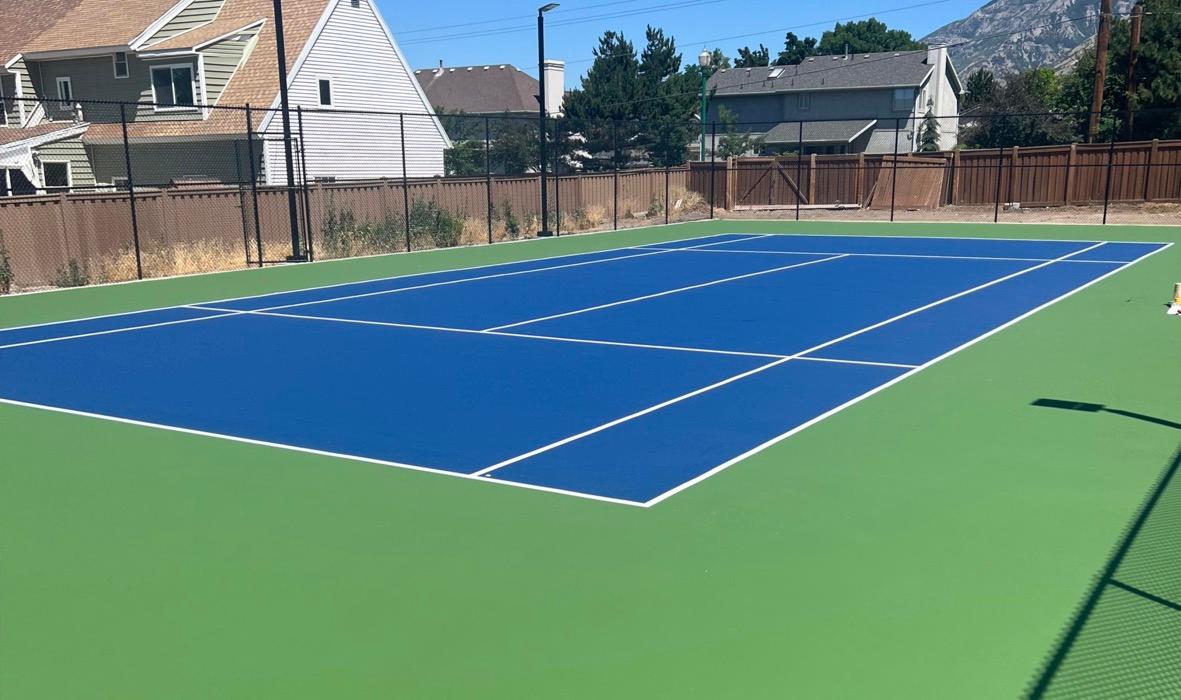
A full-size tennis court, sixty feet by a hundred and twenty. At that size it has to be post-tension — a conventionally reinforced slab that large will crack. It is a six-inch slab with a twelve-inch thickened edge around the outside, and cables tensioned in both directions across the court, each stressed to 33 kips. That is what holds a slab this size in compression and keeps it from cracking as it ages. The site was the other half of the job. It was full of mature trees — firs among them — and trees mean roots. The excavation had to be thorough and deep enough to take the roots out with them, because roots left beside a court will lift it later. Traditional colours — grass green outside, navy inside. A ten-foot fence right the way round, which is what a tennis ball needs, with proper gates rather than the open corners a pickleball court can get away with. Lighting is on full twenty-foot poles aimed downward, so the court is bright to play on without throwing light across the neighbourhood.
Questions we get asked in Orem
How much space do I need for a tennis court?
Sixty by a hundred and twenty feet for the court itself, plus room for the fence line and access around it.
Does a tennis court really need post-tension?
At this size, yes. A conventionally reinforced slab of 7,200 square feet will crack. Post-tensioning holds it in compression so it does not.
What happens if trees are close to the court?
Their roots have to come out during excavation. Roots left in place grow under the slab and lift it, which is not a repairable problem once it starts.
Will the lights bother the neighbours?
They should not. Twenty-foot poles with downward-facing fixtures keep the light on the court rather than across the street.